How Did Andrew Tate Make His Money?
Andrew Tate has become one of the most talked-about internet personalities in recent years. Many people search online to understand his lifestyle, businesses, and reported financial success. One of the most common questions is how did Andrew Tate make his money? His known and reported income sources include professional kickboxing, online businesses, paid membership programs, and internet-based ventures.
Tate first gained public attention as a professional kickboxer. However, his later online businesses became more closely associated with his public image and reported wealth. He built a large internet following and used that attention to promote paid programs and other ventures.
His highly visible online persona also kept his name in public discussion. However, estimates of his personal net worth and the earnings of individual businesses vary widely. Therefore, claims about specific amounts should be treated carefully.
How Did Andrew Tate Make His Money?
Andrew Tate’s financial story involves several stages rather than a single source of income. First, he competed professionally in kickboxing and won world titles in the sport. His athletic career gave him recognition, but his later business activities played a larger role in his reputation for wealth.
After kickboxing, Tate became involved in internet-based businesses. He and his brother Tristan have been associated with a webcam business, paid online courses, and membership programs. As a result, these ventures gave them ways to earn money from customers and subscribers online.
At the same time, Tate used social media to build his personal brand. Understanding What Is PR provides useful context for how communication, reputation, and public attention can influence a personal brand.
Tate became particularly skilled at attracting attention online. Clips from interviews, podcasts, and other appearances circulated widely across social platforms. Consequently, his name reached audiences far beyond his original kickboxing following.
How Andrew Tate Built His Early Wealth
Professional kickboxing provided Tate with an early platform. He competed for years and gained recognition through championship success. Nevertheless, his sports career alone does not explain the wealth associated with his later public image.
His move into online business created opportunities to reach a much larger customer base. Unlike fight earnings, which depend on individual events, subscription-based businesses can generate recurring revenue while memberships remain active.
One of Tate’s best-known online ventures was Hustler’s University, a paid online program that offered material on subjects such as freelancing, e-commerce, investing, and other approaches to earning money. The program later evolved into other branded online communities.
Affiliate-style promotion also helped these programs gain visibility. Members and supporters circulated Tate-related content across social media, which brought more attention to his brand and products. For readers unfamiliar with this model, How to Start Affiliate Marketing With No Money explains how affiliate promotion can work as an online business strategy.
How Online Programs Helped Andrew Tate Make Money
Paid memberships became an important part of Tate’s business model. Instead of relying solely on advertising or entertainment income, his online communities charged users for access to educational content and private groups.
This model has a straightforward advantage for an online business. Recurring subscriptions can produce ongoing revenue rather than a single payment from each customer. Therefore, a large paying membership base can create substantial revenue.
The question of how did Andrew Tate make his money also involves the scale of his online operations. A UK court ruling concerned allegations that Andrew and Tristan Tate had failed to pay tax on about £21 million in revenue from online businesses between 2014 and 2022. Reuters reported on the UK court ruling and online-business revenue.
However, business revenue is not the same as Andrew Tate’s personal profit or net worth. Expenses, taxes, ownership arrangements, and other factors affect how much money an individual keeps. For that reason, viral claims about his exact fortune should not automatically be treated as verified facts.
How Andrew Tate Made Money Through His Online Brand
Social media played a major role in expanding Tate’s audience. His provocative statements, interviews, and short-form clips generated widespread discussion. Whether viewers supported or criticized him, that attention increased awareness of his name and businesses.
That visibility had commercial value because a large audience could be directed toward paid products and communities. In this sense, social media worked as a marketing channel for businesses connected to his personal brand.
However, a large number of views does not mean that every view produces direct income. Instead, attention can support a broader sales funnel by introducing people to products, subscriptions, websites, or other commercial offers.
The principles discussed in Digital Strategy Consulting provide broader context for how businesses can align digital channels with commercial goals.
Tate’s strategy also shows how unusual or controversial content can generate significant online attention. Similarly, Recent Innovative Marketing Examples provides broader examples of how different approaches can influence audience engagement.
How the Webcam Business Contributed to His Income
Another significant part of Tate’s business history involves a webcam operation that he ran with his brother. This venture existed before his later online education brands became widely known.
The business involved women communicating with paying customers through online webcam platforms. Tate has discussed the business publicly, while subsequent reporting and legal proceedings have brought additional scrutiny to activities involving the brothers.
Because legal proceedings involve serious allegations connected with some of their activities, those allegations should remain separate from confirmed facts about how the businesses operated. Tate and his brother have denied criminal wrongdoing.
The webcam venture remains relevant when examining his financial history because it represents one of the businesses associated with him before his later subscription programs became prominent.
Other Reported Sources of Andrew Tate’s Wealth
Tate has also spoken publicly about investments and other private business interests. However, less independently verified information is available about the financial performance of many of these ventures.
For this reason, claims about property portfolios, specific investment returns, casinos, cryptocurrency holdings, or other private assets require caution unless reliable records support them.
This distinction matters because online discussions often combine Tate’s own statements, media estimates, social media speculation, and verified financial information. However, these sources do not provide the same level of evidence.
A Business Strategy Consultant may help companies evaluate growth opportunities and develop strategic plans. In Tate’s case, diversification across different ventures appears to have formed part of his broader approach to business.
How Online Marketing Expanded Andrew Tate’s Business
One of the clearest elements of Tate’s rise was his ability to turn attention into brand awareness. Instead of depending on one social media account, clips featuring him circulated across numerous accounts and platforms.
Consequently, people repeatedly encountered his name even when they did not follow his official profiles. This distribution increased searches, conversations, and interest in his businesses.
Interviews and podcast appearances reinforced the effect. For example, short clips could reach new audiences, while longer appearances gave Tate opportunities to discuss his lifestyle, opinions, and commercial ventures.
However, visibility should not be confused with personal wealth. Social media exposure helped promote his brand, but publicly available information does not provide a complete breakdown of how much profit each source produced for him personally.
How Andrew Tate Built Wealth From Multiple Income Sources
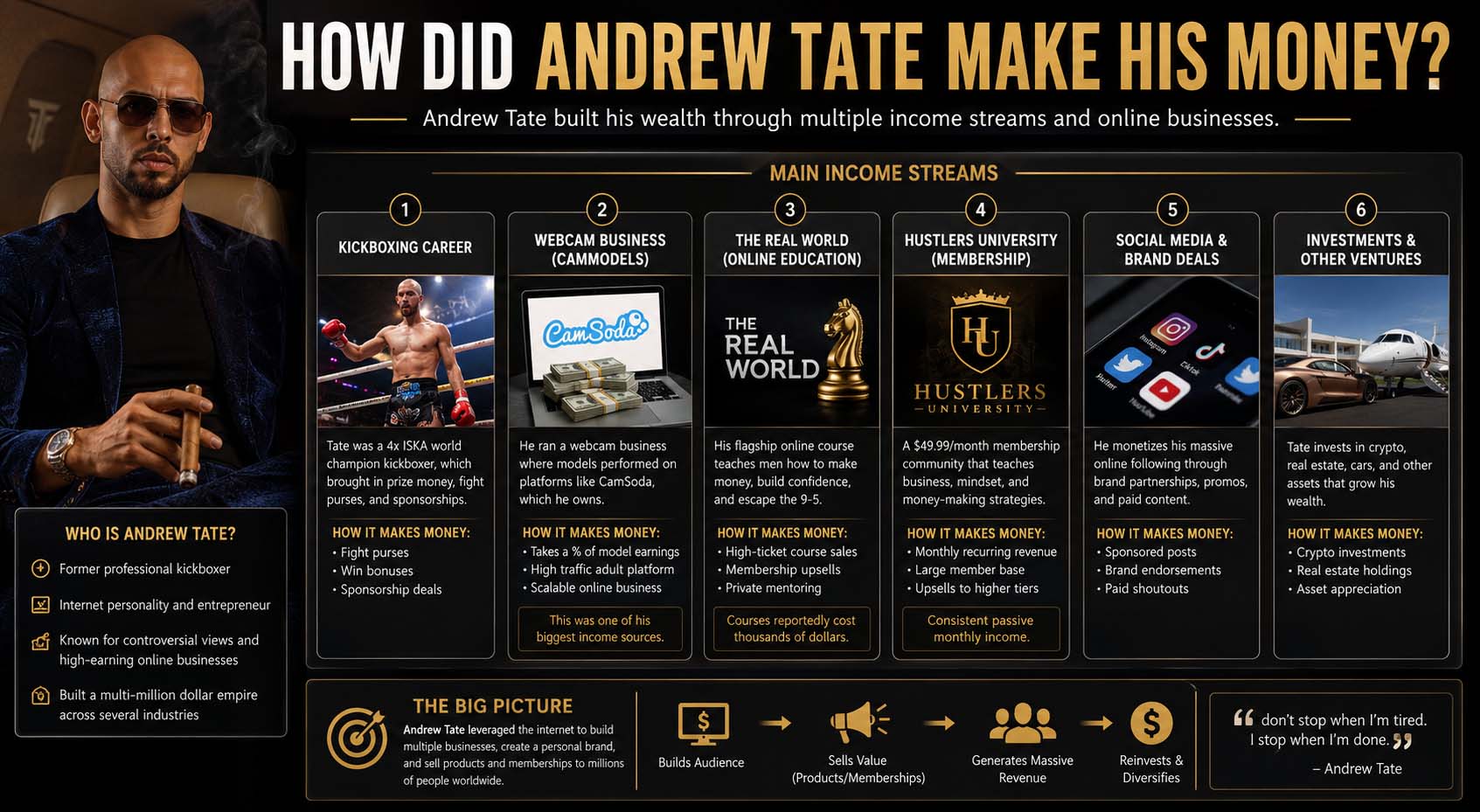
Several income sources help explain how did Andrew Tate make his money and build his reported wealth. His kickboxing career established his early public profile, while his later internet ventures expanded his commercial reach.
His major known or reported sources have included:
- Professional kickboxing and related earnings
- A webcam business operated with his brother
- Paid online courses and membership communities
- Digital products and internet-based businesses
- Personal-brand marketing and online promotion
- Other private ventures and investments he has discussed publicly
These sources did not necessarily contribute equally to his wealth. In particular, available reporting indicates that his online businesses generated substantial revenue, while his kickboxing career primarily established his early reputation.
Andrew Tate’s Wealth and Business Strategy
So, how did Andrew Tate make his money over the course of his career? His financial path moved from professional sport into internet entrepreneurship, while his highly visible personal brand helped promote his online ventures.
His financial story also demonstrates why revenue, profit, and net worth should not be treated as interchangeable terms. A business can generate substantial revenue without that entire amount becoming the owner’s personal income.
Likewise, expensive cars, watches, properties, and travel may create an image of wealth, but they do not independently verify someone’s net worth. Reliable financial records and court documents provide stronger evidence than social media appearances or unsupported online estimates.
Overall, Tate’s reported income history can be understood through a combination of professional kickboxing, online businesses, subscription programs, a webcam operation, and other reported ventures. His ability to attract large amounts of online attention then helped promote those businesses to a much wider audience.